
Compressed air | Medical grade
A system, not a compressor.
Medical air does not end at the equipment that compresses it: it ends at the outlet by the patient’s bed. Between those two points there is a chain, and every link changes the quality of the air that is delivered.
The chain, link by link
Tap any point along the path to see what it does and what happens if it fails.
01Generation
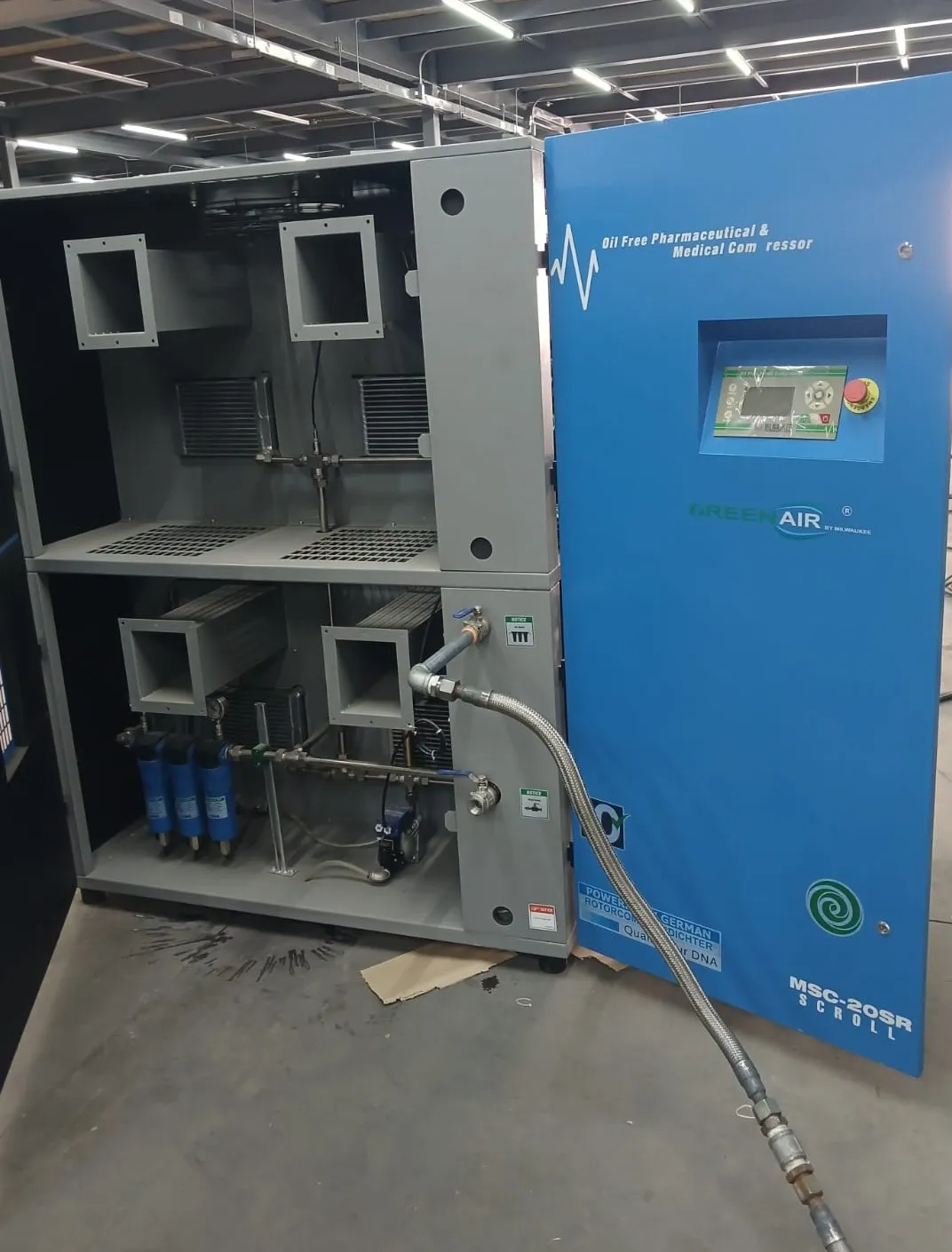
Oil-free compressors, sized to the facility’s actual demand and with redundancy: servicing one module never interrupts supply.
A single unit with no backup leaves the facility without medical air every time it needs servicing, and running permanently at its limit it wears out early.
02Storage
The tank absorbs demand peaks and keeps the equipment from starting and stopping without rest.
Without a tank the compressors start and stop with every change in demand: pressure swings at the outlets and the equipment’s service life is cut short.
03Drying
Water is the enemy of the network. Drying controls the dew point before the air enters the piping.
Water condenses inside the piping, corrodes the network from within and ends up reaching the outlet at the patient’s bed.
04Filtration
Successive stages for particles, oil and odours, up to the quality clinical use requires.
Particles and oil pass into the network. Once the piping is contaminated, cleaning it costs far more than filtering would have.
05Control and monitoring
Control panel, alarms and continuous monitoring of dew point and carbon monoxide.
No one finds out the air quality has changed until somebody notices it in the clinical area. The alarm exists precisely so that does not happen.
06Distribution
The piping network and its supports, from the machine room to every area of the facility.
The wrong piping material or poor supports: pressure drops in the farthest areas and leaks nobody sees but everybody pays for, month after month.
07Outlets and manifolds
Where the system meets the clinical staff. It is the only part the hospital sees every day.
An outlet that does not seal, or that does not match the gas it delivers, is a direct risk at the patient’s bedside.
08Commissioning
Air quality testing, certificate, drawings, calculation report and training for the maintenance staff.
With no testing and no certificate there is no way to prove what air quality was delivered, and with no drawings or training the hospital cannot operate its own system.
How air quality is measured
ISO 8573-1 classifies compressed air with three numbers: solid particles, water content and oil content. Each application calls for a different combination, and saying “clean air” without those three numbers means nothing. Every catalog page states the equipment’s class.
See the catalog →Which class are you being asked for?
If your facility has an air quality specification, it is written as three numbers. Enter them here and we will tell you what each one demands and which part of the system delivers it.
One digit per contaminant. The lower the number, the cleaner the air.
Enter the digits you were given and you will see what each one demands.
What your specification demands
Particles
How many solid particles are left in the air reaching the outlet.
Delivered by the filter train, in successive stages.
Water
How much moisture the air carries, measured as dew point.
Delivered by the dryer, and watched by the dew point monitor.
Oil
How much oil the air carries, as aerosol, liquid and vapour.
Delivered by oil-free compression and the activated carbon filter.
The class is delivered by the whole system — compression, drying and filtration — not by a single piece of equipment. What was actually achieved is proven by the commissioning tests.
What the catalog states today
One party responsible
When one supplier sells the equipment, another lays the piping and a third runs the tests, the facility is left with no one to call. We deliver the whole chain and answer for it.
Case studies →Reliability that backs up lives.
Request a quote